
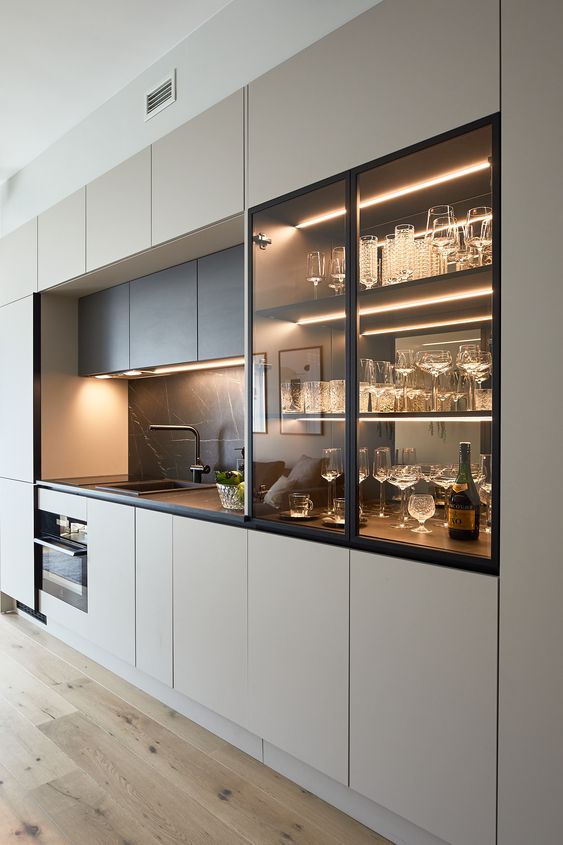
Doors and drawers are the interface. Specifying the motion once, and never substituting it, is the least glamorous luxury in the room.
Ask someone what they remember about a kitchen and they rarely mention the door profile. They mention that the drawer glided out fully loaded, or that the lift door stopped exactly where their hand left it.
That is motion, and it is engineered rather than styled. I specify Blum throughout, on every commission, without exception, because consistency across a room matters more than any single component.
What that means in practice
LEGRABOX for drawers, so the side walls stay slim and the runners carry real weight to full extension. AVENTOS where a door needs to lift clear of a working head height. SERVO-DRIVE where a handleless front needs to open at a touch. BLUMOTION on all of it, so nothing ever slams.
Why substitution is refused
Mixed hardware ages at different rates. One runner develops a rattle, one hinge sags, and the kitchen begins to feel tired while the timber and stone still look new. Keeping the mechanism uniform is the cheapest way to protect an expensive room.
Keep reading
Why a three millimetre reveal changes a whole room
The gap between two doors is not a tolerance. It is a decision, and it sets the rhythm of everything you look at afterwards.
MaterialChoosing a slab: veining, book-matching and the cut you cannot undo
Stone is bought by the piece, not the square metre. Standing in the yard with a marker is the most important hour of the project.